Thursday, November 5, 2015

Bernie Sanders and Social Security

Bernie Sanders Views on Social Security

 Senator Bernie Sanders is running in the 2016 political election for president. His views of the fiscal policy are mostly liberal, which appeal to the younger generation. If we take a look at social security, which mostly appeals to the older generation, Sanders' supports expanding the program through the Keeping Social Security Promises Act.

These are his words on the topic of social security:

"I will be introducing the Keeping Social Security Promises Act as soon as the Senate gets back into session. This legislation will strengthen Social Security for the next 75 years by asking the wealthiest Americans to pay their fair share into Social Security. Specifically, my legislation would apply all income over $250,000 a year to the Social Security payroll tax. The Chief Actuary of the Social Security Administration has projected that doing this will ensure that Social Security can pay out all benefits for at least the next 75 years. In fairness, I can't take credit for this legislation. It is exactly what Barack Obama proposed to do when he campaigned for President back in 2008." (senate.gov)

This act will cost the government money but it will be beneficial. It will help out real GDP in the long term. I hope Senator Bernie Sanders will win the 2016 election!

Friday, October 2, 2015

Carbon Tax vs. Cap and Trade

Our world is full of pollution. If I were elected leader, then I would impose carbon taxes. Carbon taxes impose a tax on each unit of greenhouse gas emissions and gives companies an incentive to reduce pollution. It costs companies less to pay a carbon tax than to pay the regular tax. 

Many people say cap and trade is better. I believe this is not true because cap and trade "sets a maximum level of pollution, a cap, and distributes emission permits among firms that produce emissions. Companies must have a permit to cover each unit of pollution they produce, and they can obtain these permits either through an initial allocation or auction, or through trading with other firms." 

The negatives to cap and trade are that it provides uncertainty about the cost of achieving reductions. 

Attached is what Carbon tax and Cap And Trade graph would look like: 


Here is the article: http://www.theguardian.com/environment/2013/jan/31/carbon-tax-cap-and-trade 

Friday, September 18, 2015

Supply and Demand on Gasoline

September 18th, 2015


This week in Macro, we talked all about supply and demand. According to NY Times, (link below), gas isn't cheap anymore and that is affecting our economy and environment. 

The article talked about supply and demand. It said "The most obvious way to hold down the price of oil is to increase its supply." This shows an inverse relationship. However, in class we learned that as price decreases, the quantity of supply also decreases, making it a direct relationship.

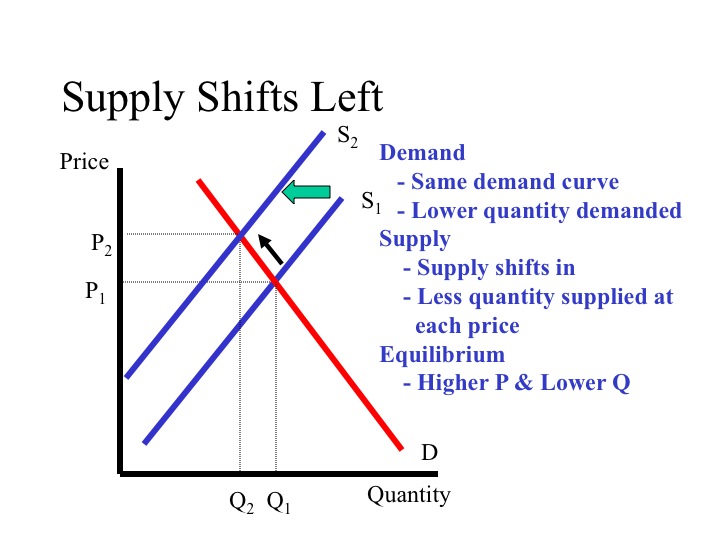
We use supply and demand in our lives everyday. Pretend there is a drought in Florida, when you go to the store to get oranges, (something that is usually mass produced there), the price of oranges will be higher than usual. This is because of the rules of supply and demand. Since the supply of oranges went down due to the drought, the supply curve shifted down. Also, there was a movement along the demand curve because the prices increased. You can see this in the picture below. 

Now, to connect this back to gasoline, if gas prices increase, then the demand for gas decreases. Less people will choose to drive to work or school. Which causes a movement in the demand curve and the supply curve stays the same.


http://www.nytimes.com/2015/01/27/upshot/gas-still-not-as-cheap-as-it-used-to-be.html?_r=0

Monday, September 7, 2015

Economics In our Daily Lives

September 7th, 2015

Believe it or not, we use economics in our daily lives. Whether it's deciding what to get to eat or deciding if you should go hang out with your friends, economics play a role. 

This week in Macro Economics class, we learned all about marginal costs and marginal benefits. In an ideal situation, you would want the marginal benefits to be higher than the cost.

When deciding what to eat, you must think of time and cost. How much is the food? Is the restaurant I want to go to far away? Will it take too much time? After considering all of this, you can decide if going to that place is worth your time. This also applies when you are deciding if you should go hang out with your friends or not. For example, this weekend my friends wanted to go to Septemberfest. I really wanted to go but I had family that I hadn't seen in a year come over for the long weekend. I decided to spend time with them because I get to see my friends all the time, but family only once in a while. In this case, the cost of me going was higher than the benefit.